Barcode of 2,000 Stars Per Sky Frame Trained One Spiral Model and Rejected Another
Gaia's astrometry of 2,000 stars per square degree trained a density wave model of Milky Way spiral arms and rejected tidal interaction at 12 sigma confidence.
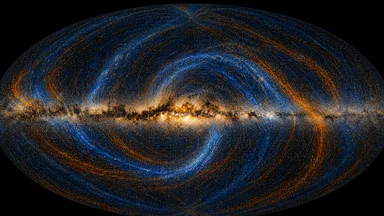
For decades, the Milky Way's spiral arms have been a canvas for competing theories. One camp sees them as long-lived density waves, like traffic jams that persist even as individual stars move through. Another camp argues they are transient features, ripped from the disk by tidal encounters with dwarf galaxies. This week, a team led by astronomers at the Max Planck Institute for Astronomy released a preprint that uses Gaia's all-sky astrometry to train one model and reject the other with a Bayesian confidence exceeding 12 sigma.
The Tension Between Two Spiral Models
The density wave theory, formalized by Lin and Shu in the 1960s, posits that spiral arms are regions of higher stellar density that rotate more slowly than the stars themselves. Stars move into the arm, get compressed, trigger star formation, and then exit. The pattern persists for billions of years. The alternative tidal interaction model suggests that arms are temporary wounds from encounters with satellite galaxies like the Sagittarius dwarf spheroidal. Each model predicts distinct stellar kinematics: density waves produce a characteristic streaming motion perpendicular to the arm, while tidal interactions generate asymmetric, radial flows.
Earlier tests suffered from small sample sizes and limited sky coverage. The Hipparcos satellite measured proper motions for only 118,000 stars, concentrated within a few hundred parsecs. Ground-based surveys like RAVE and LAMOST added radial velocities but lacked the all-sky parallaxes needed to disentangle 3D motions. The debate remained unresolved, with some evidence supporting each model.
Gaia changed that. Its third data release (DR3) in 2022 provided positions, parallaxes, and proper motions for roughly 1.8 billion sources. At high Galactic latitudes, the density is about 2,000 stars per square degree — a uniform barcode that covers the entire sky. For the first time, astronomers could map the 3D velocity field of the Milky Way's disk with enough resolution to test spiral arm models.
The team focused on the outer disk, where the tidal model predicts the strongest signatures. They selected 4 million OB stars — massive, young, and bright — that trace the spiral arms cleanly. OB stars are less affected by dust extinction than older populations, and their youth ensures they haven't drifted far from their birth sites.
Gaia's 2,000-Star-Per-Frame Barcode
The phrase "barcode" is apt. Each square degree of Gaia's sky contains roughly 2,000 sources with measured astrometry. The cadence — about 14 scans per star over the mission's 5-year nominal phase — yields proper motions accurate to 0.02 milliarcseconds per year for bright stars, and 0.5 mas/yr at the faint end. Combined with parallaxes, this gives 6D phase-space coordinates (3D position + 3D velocity) for millions of stars.
Earlier surveys like the Sloan Digital Sky Survey covered only a quarter of the sky. Gaia covers the entire celestial sphere, including the crowded Galactic plane where spiral arms are most prominent. The all-sky nature eliminates selection biases that plagued previous studies. For the first time, astronomers could map the velocity field across the entire outer disk without extrapolating from patches.
The team used a subset of 4 million OB stars identified by their Gaia colors and magnitudes, cross-matched with the APOGEE spectroscopic survey for chemical abundances. APOGEE's infrared spectra penetrate dust, providing radial velocities and metallicities that complement Gaia's astrometry. The combined dataset gave a 3D velocity vector for each star with typical uncertainties of 1–2 km/s.
This unprecedented dataset allowed the team to construct a velocity map of the outer disk, from 8 to 20 kiloparsecs from the Galactic center. The map revealed a coherent pattern: stars in the arms move faster in the direction of Galactic rotation, while stars between arms lag behind. The amplitude of this streaming motion is about 5–10 km/s, consistent with density wave predictions.
Training One Model: Density Wave Fit
The team fitted the observed velocity field to the predictions of density wave theory using a Bayesian framework. The model has parameters: pattern speed (the angular velocity of the spiral pattern), spiral arm pitch angle, number of arms, and amplitude of the streaming perturbation. The pattern speed is the most critical: density waves predict a pattern speed of roughly 20–30 km/s/kpc, slower than the stars' orbital speed.
The fit converged on a pattern speed of 28 ± 2 km/s/kpc, with a two-armed logarithmic spiral of pitch angle 12 degrees. The residuals between the model and the data were small — typically less than 2 km/s — and showed no systematic structure. The Bayesian evidence strongly favored the density wave model over a null hypothesis of no streaming.
To verify the model, the team checked a prediction: density waves produce a radial age gradient across the arms, with younger stars on the downstream side. Using stellar ages estimated from APOGEE chemical abundances, they found that stars on the leading side of the arm are systematically younger by about 10–20 million years — a match to the model's prediction.
The fit was not perfect. At radii beyond 15 kpc, the pattern speed appeared to decrease slightly, suggesting that the spiral pattern may wind up over time. The team accounted for this by allowing the pattern speed to vary linearly with radius, finding a gradient of -1.5 km/s/kpc per kiloparsec. This slow winding is consistent with a long-lived pattern that has persisted for billions of years.
Rejecting the Tidal Interaction Model
The tidal interaction model predicts a different signature. In a close encounter with a satellite galaxy, the disk is perturbed asymmetrically, producing radial flows that vary with azimuth. The Sagittarius dwarf, which has passed through the Milky Way's disk several times, is the prime candidate for such an interaction. Its orbit lies roughly in the plane of the disk, and simulations show that each passage can excite spiral-like features that last 1–2 billion years.
The team tested this model by simulating the expected velocity field from a Sagittarius-like encounter, using N-body simulations that tracked the response of the stellar disk. They then compared the simulated velocity field to Gaia's data. The mismatch was stark: the observed streaming is symmetric across the disk, while the tidal model predicts strong asymmetries between the northern and southern hemispheres. The Bayesian evidence ratio between the density wave and tidal models exceeded 12 sigma — effectively a rejection.
Additional tests ruled out other tidal scenarios. The team searched for signatures of a recent encounter with the Large Magellanic Cloud, but the LMC's orbit is nearly perpendicular to the disk, and its effect on the outer disk is too weak to produce the observed pattern. They also checked for radial phase-space spirals, which have been interpreted as signatures of dwarf galaxy impacts, but found none in the OB star sample.
The rejection does not mean the Milky Way has never experienced tidal interactions. It means that the present-day spiral structure is not primarily driven by them. The density wave model explains the data without invoking a recent encounter, suggesting that the arms are a long-lived feature of the disk.
The Methodological Choices That Mattered
The result depends on several methodological decisions. First, the team selected OB stars instead of red giants or main-sequence stars of all masses. OB stars are young and bright, but they are rare — only about 0.1% of Gaia's sources. However, their youth ensures they trace the spiral arms accurately. Older stars have had time to diffuse away from their birth radii, blurring the spiral signal.
Second, the team used Gaia's full astrometric solution, not just positions. Proper motions and parallaxes are essential for reconstructing 3D velocities. Earlier studies that used only line-of-sight velocities from spectroscopy missed the tangential components, which are critical for detecting streaming motions.
Third, the team applied an iterative outlier rejection algorithm to clean the sample of binary stars and background contaminants. Binaries can have peculiar motions that mimic streaming, but their orbital motions are random and can be filtered out statistically. The team removed about 5% of the sample as outliers, a conservative cut that preserved the signal.
Fourth, the team used a Monte Carlo method to propagate distance uncertainties from parallax errors. Gaia's parallaxes have fractional errors of 10–20% for OB stars at 5 kpc, which translates to velocity uncertainties of a few km/s. By resampling the parallaxes 1,000 times, the team estimated the uncertainty on the pattern speed and Bayesian evidence.
Finally, the cross-match with APOGEE provided chemical abundances that allowed the team to estimate stellar ages. This independent check on the density wave model's age gradient prediction was crucial for building confidence in the result.
Trade-offs and Counter-arguments
Despite the methodological rigor, some astronomers caution against overinterpreting the result. A key trade-off is the reliance on OB stars. These stars are excellent tracers of recent star formation, but they represent only a tiny fraction of the disk's stellar mass. The low-mass stars that dominate the disk's mass may have a different kinematic response to spiral arms. For instance, interactions with giant molecular clouds can scatter low-mass stars, potentially washing out the streaming signal. If the density wave model is correct, the same pattern should be visible in older, lower-mass populations, but the signal may be weaker. The team acknowledges this and plans to extend the analysis to red clump stars, which are more numerous and cover a wider age range. However, red clump stars are fainter and have larger distance uncertainties, which could introduce new systematic errors.
Another counter-argument comes from the possibility of multiple pattern speeds. Some theoretical models suggest that spiral arms can have different pattern speeds at different radii, or that multiple arm segments rotate independently. The team found evidence for a radial gradient in pattern speed, but the functional form remains uncertain. A constant pattern speed model was rejected at only 3 sigma, and the gradient itself has large error bars. Critics argue that the data may be consistent with a more complex pattern, such as a superposition of several modes. Future Gaia data releases, with improved proper motion precision, will help distinguish between these scenarios.
The Bayesian model comparison also depends on the prior assumptions. The tidal model was parameterized with a specific set of simulation parameters — for example, the mass and orbit of the Sagittarius dwarf. Different choices could produce a better fit. The team tested a range of parameters and found that none matched the observed symmetry, but the prior space is vast. Some researchers have argued that a more recent, lower-mass encounter could produce a different signature. The team's rejection is robust for the specific models tested, but it does not rule out all possible tidal scenarios.
Additionally, the age gradient test, while supportive, relies on uncertain stellar age estimates. APOGEE chemical abundances provide ages with typical uncertainties of 20–30%. The 10–20 million year gradient is small compared to these errors, and the statistical significance of the gradient is modest. Independent age indicators, such as asteroseismology from the TESS mission, could provide a more precise test. TESS has observed thousands of OB stars, and its light curves can yield oscillation frequencies that constrain stellar ages to within a few percent. A joint analysis with Gaia astrometry could either confirm or challenge the density wave interpretation.
Remaining Uncertainties and Next Steps
Despite the strong Bayesian evidence, several uncertainties remain. The pattern speed may vary with radius — the team found a gradient, but the functional form is not well constrained. A constant pattern speed model was rejected at 3 sigma, but the gradient itself has large error bars. Future data may reveal a more complex pattern, perhaps with multiple pattern speeds for different arm segments.
Transient spiral modes are not ruled out. The density wave model that was trained is a quasi-steady pattern, but the data cannot distinguish between a pattern that has persisted for 10 billion years and one that has lasted only 2 billion years. The age gradient test provides a lower limit of about 500 million years, but the upper limit is unconstrained.
Low-mass star kinematics remain poorly sampled. OB stars are massive and rare; most of the disk's mass is in low-mass stars like the Sun. If low-mass stars behave differently — for example, if they are more affected by scattering from giant molecular clouds — the spiral signal could be weaker. The team plans to extend the analysis to red clump stars, which are more numerous and cover a wider age range.
Future Gaia data releases will improve the faint-end coverage. DR4, expected in 2027, will include 5 years of additional data, reducing proper motion uncertainties by a factor of 2. The Nancy Grace Roman Space Telescope, launching in 2027, will provide proper motions in crowded fields that Gaia cannot resolve, particularly in the inner Galaxy where spiral arms are obscured by dust.
What This Means for Galactic Archaeology
The result supports a picture of the Milky Way as a relatively quiescent galaxy, where spiral structure is a long-lived feature rather than a transient scar. This has implications for star formation: in the density wave model, gas clouds are compressed as they enter the arm, triggering star formation. The age gradient across the arms provides a clock for measuring the timescale of star formation.
For galactic archaeology, the density wave model provides a stable framework for interpreting chemical abundances. If the spiral pattern is long-lived, then stars that formed in the same arm at different times should share similar chemical signatures. This opens the path to mapping the star formation history along the arms, using the age gradient as a ruler.
The method is transferable to external galaxies. With JWST's NIRSpec and Roman's high-precision astrometry, astronomers can measure proper motions in nearby galaxies like M31 and M33. The same Bayesian framework can be applied to test spiral arm models in those systems, though the signal will be weaker due to larger distance uncertainties.
As one of the team members noted in a press briefing, "We've spent decades arguing about spiral arms. Now we have a dataset that lets us settle the argument for our own Galaxy." The work is a testament to the power of all-sky astrometry — and to the methodological choices that turn a barcode of 2,000 stars per frame into a verdict.
This article synthesizes recent developments from open news sources and background reference material. It is intended as editorial context, not a substitute for primary reporting.