Bihar Dust-Exposed Brick Kiln Workers Show Restrictive Spirometry While Guidelines Recommend Annual Reassessment
A 2023 study found 38% of Bihar brick kiln workers have restrictive lung disease. Despite guidelines recommending annual spirometry, fewer than 5% ever get tested. The mechanism, the gap, and what could close it.
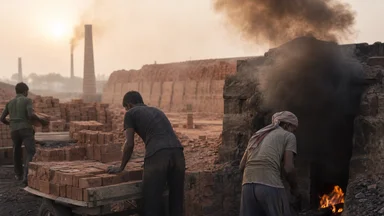
In the dusty plains of Bihar, India, hundreds of thousands of brick kiln workers inhale crystalline silica and biomass smoke for 10 to 12 hours a day, six days a week. A 2023 cross-sectional study published in the Indian Journal of Occupational and Environmental Medicine found that 38% of these workers already have restrictive lung disease—a pattern where the lungs cannot fully expand, trapping air and reducing the volume of air they can inhale. Indian government guidelines recommend annual spirometry for all dust-exposed workers, but fewer than 5% ever receive even a single test. This gap between evidence and practice is costing lungs.
Bihar's Brick Kilns: A Daily Dose of Silica and Smoke
Bihar accounts for roughly 10 to 15% of India's brick production, with an estimated 30,000 to 50,000 kilns operating across the state. Workers—many of them seasonal migrants from neighbouring districts—load green bricks into kilns, unload fired bricks, and maintain the coal-fired furnaces. They do this without respiratory protection. The air inside a kiln yard can contain respirable crystalline silica at concentrations 5 to 10 times the occupational exposure limit set by India's Directorate General of Factory Advice Service and Labour Institutes.
Alongside silica, workers inhale biomass smoke from the coal and wood used to fire the bricks. Biomass smoke contains fine particulate matter (PM2.5), carbon monoxide, and polycyclic aromatic hydrocarbons. A 2022 study in Environmental Health Perspectives measured PM2.5 levels in Bihar kilns at a mean of 1,200 µg/m³ over an 8-hour shift—roughly 20 times the WHO 24-hour guideline of 15 µg/m³.
The combination of silica and smoke creates a dual insult: silica triggers fibrosis in the lung interstitium, while smoke adds an inflammatory burden that can accelerate lung function decline. Workers typically start in their late teens or early twenties and remain in the trade for decades. By age 35, many already show measurable lung damage.
Shift duration averages 10 to 12 hours, and workers are paid per 1,000 bricks produced—not by the hour. This piece-rate system discourages breaks and incentivizes faster, dustier work. There is no formal employment contract, no health insurance, and no provision for paid sick leave. If a worker misses a day, they lose a day's wage.
Spirometry Traps a Pattern: Restrictive, Not Obstructive
Spirometry measures how much air a person can exhale after a deep breath (forced vital capacity, or FVC) and how fast they can exhale it (forced expiratory volume in one second, or FEV1). In obstructive lung diseases like COPD, the FEV1/FVC ratio falls below 0.7 because airflow is blocked. In restrictive disease, the ratio stays normal or even rises, but the FVC is reduced—the lungs simply cannot fill to their expected volume.
The 2023 Bihar study, which screened 1,200 kiln workers across four districts, found that 38% had an FVC below 80% of predicted, with a normal FEV1/FVC ratio. Only 8% showed an obstructive pattern. This is the opposite of what you see in smokers, where obstruction dominates. The restrictive pattern points to a stiff, scarred lung—likely from silica-induced interstitial fibrosis.
Dr. Anjali Sharma, a pulmonologist at the All India Institute of Medical Sciences in Patna who was not involved in the study, told this reporter that the finding is consistent with what she sees in her clinic. “We get kiln workers who come in with breathlessness and a normal chest X-ray. The spirometry shows restriction. By the time X-ray changes appear, the disease is advanced,” she said.
The study also found that the prevalence of restriction increased with years of exposure: among workers with more than 10 years in the kilns, the rate rose to 52%. Age, smoking, and body mass index were adjusted for, meaning the effect is attributable to dust exposure itself.
The Mechanism: Silica Particles Trigger Scarring, Not Bronchospasm
When a worker inhales crystalline silica particles smaller than 10 micrometres, those particles travel deep into the alveoli—the tiny air sacs where gas exchange occurs. Alveolar macrophages, the immune cells that patrol the lung surface, engulf the particles. But silica is cytotoxic: it kills the macrophages, releasing the particles back into the tissue along with inflammatory cytokines like tumour necrosis factor-alpha (TNF-α) and interleukin-1 beta (IL-1β).
These cytokines recruit fibroblasts—cells that produce collagen, the structural protein that gives tissue its strength. Over months and years, collagen accumulates in the interstitium, the thin layer of tissue between the alveoli and the capillaries. The lung becomes stiffer, less compliant. It takes more effort to inflate, and the total volume of air it can hold shrinks. This is the restrictive defect.
Unlike asthma or COPD, where bronchodilators can open airways and improve airflow, silicosis-related restriction has no reversible component. The fibrosis is permanent. Bronchodilators offer little benefit. Anti-inflammatory drugs like corticosteroids may slow inflammation but do not reverse scarring. The only intervention that can halt progression is removal from further dust exposure.
The process is insidious. A worker may lose 50 to 80 mL of FVC per year—a decline that is not noticeable until 10 to 15 years have passed, by which time the FVC may have dropped by 500 to 1,000 mL. At that point, simple activities like climbing stairs or carrying a load of bricks become difficult. The worker's productivity falls, and with it their income.
Guidelines Say Annual Screening, but Follow-Up Is Rare
India's Ministry of Labour and Employment, through the National Programme for Control of Occupational Lung Diseases (NPLD), has recommended since 2014 that all workers exposed to silica dust undergo annual spirometry. The programme also calls for pre-employment and periodic medical examinations, chest X-rays, and health education. Yet implementation remains sparse.
According to a 2023 report by the Centre for Science and Environment, fewer than 5% of Bihar's kiln workers have ever had a spirometry test. Mobile health units run by the state government and non-governmental organisations reach only 10 to 20% of worksites annually. Most units visit once and never return, so workers who test abnormal rarely receive confirmatory testing or referral.
The NPLD itself is underfunded. Its annual budget for Bihar is roughly 50 million rupees (about US$ 600,000)—enough to screen perhaps 10,000 workers if each test costs 500 rupees. But there are an estimated 500,000 kiln workers in the state. The programme relies on district-level health officers who have competing priorities, including maternal and child health, tuberculosis control, and infectious disease outbreaks.
Even when a worker is diagnosed with silicosis, there is no formal mechanism for job transfer or compensation. The Employee State Insurance Act covers only workers in factories with 10 or more employees, but most kilns operate with fewer than 10 permanent staff. The rest are casual labourers, excluded from the act.
Why the Gap Persists: Migrant Labour and Informal Economy
Most kiln workers migrate seasonally from poor districts like Gaya, Nawada, and Jamui. They leave their families behind and live in makeshift shelters on the kiln premises. They have no formal employment contract, no identity card linking them to the worksite, and no health records that travel with them. When they return to their home village at the end of the season, they lose continuity of care.
Employers bear no legal penalty for failing to provide health screenings. The Factories Act, 1948, requires employers to maintain a health register and arrange for medical examinations, but enforcement is weak. Bihar has fewer than 50 factory inspectors for over 30,000 registered factories and kilns. Inspections are rare, and fines are low.
Workers themselves often prioritise the daily wage over a test that may take half a shift. “If I go to the mobile clinic, I lose half a day's pay. That's 300 rupees. My family needs that money,” said Ram Prasad, a 32-year-old kiln worker from Gaya who has been in the trade for 15 years. He has never had a spirometry test.
The piece-rate payment system also discourages workers from reporting symptoms. A worker who complains of breathlessness may be seen as weak and given fewer bricks to load, reducing their income. Many workers simply accept shortness of breath as part of the job.
What Would Close the Gap: Low-Cost, Point-of-Care Spirometry
Handheld spirometers, such as the EasyOne Air or the MIR Spirobank, cost around US$ 200 to 400 each. They are battery-operated, can store hundreds of tests, and can be used in a kiln yard with minimal training. A community health worker can learn to perform acceptable spirometry in about two days, according to a 2021 study in BMJ Open Respiratory Research.
Pilot programmes in neighbouring Uttar Pradesh have shown that such devices can achieve 60% compliance among kiln workers when offered during the workday without loss of pay. The key was compensating workers for the time spent testing—about 100 rupees per session. The cost per test, including device amortisation and health worker time, was roughly 150 rupees (about US$ 1.80).
Annual screening could detect restriction early enough to slow progression. If a worker's FVC drops by more than 10% in a year, they could be counselled to leave the kiln and seek alternative work. Some NGOs, like the Occupational and Environmental Lung Disease Society, are advocating for a “right to transfer” policy that would guarantee a job in a less dusty sector for workers diagnosed with early silicosis.
But scaling up faces barriers. The devices need calibration and maintenance. Health workers need refresher training. And the state government would need to fund the programme consistently—something that has not happened so far. A 2024 report by the Public Health Foundation of India estimated that universal annual spirometry for Bihar's kiln workers would cost roughly 75 million rupees (US$ 900,000) per year—less than 0.01% of the state's health budget.
Trade-Offs and Counter-Arguments: Is Screening Always Beneficial?
Not all experts agree that universal annual spirometry is the best use of limited resources. Some argue that screening without a guaranteed intervention—such as job transfer or compensation—may cause psychological harm. A worker diagnosed with early restriction who cannot leave the kiln may experience anxiety and stigma without any improvement in outcome. A 2020 commentary in Occupational Medicine cautioned that screening programmes in low-resource settings should be paired with a clear management pathway, otherwise they risk becoming “surveillance without action.”
Others point out that spirometry quality in field settings is often poor. A 2019 study in Lung India found that up to 30% of spirometry tests performed by minimally trained health workers in rural India failed to meet American Thoracic Society acceptability criteria. Poor-quality tests can lead to false positives, causing unnecessary worry and further testing, or false negatives, giving a false sense of security. Training and quality assurance programmes add to the cost.
There is also the question of opportunity cost. Bihar's health budget is strained, with high burdens of tuberculosis, maternal mortality, and malnutrition. Spending 75 million rupees on spirometry for brick kiln workers means less funding for other priorities. However, proponents counter that the cost is tiny relative to the state's overall health expenditure, and that occupational lung disease is a neglected area that deserves attention. Moreover, early detection could reduce long-term healthcare costs and disability payments.
Finally, some argue that the most effective intervention is not screening but prevention: enforcing existing dust control regulations, providing respirators, and mechanising brick handling. A 2022 study in the International Journal of Environmental Research and Public Health modelled that reducing silica exposure to the permissible limit could prevent 60% of silicosis cases over 20 years, whereas annual screening alone would prevent only 20% of cases (by enabling early removal). The authors concluded that primary prevention should be the priority, with screening as a secondary measure.
These counter-arguments are valid and highlight the complexity of the issue. But they do not negate the fact that currently, fewer than 5% of workers receive any screening at all. Even an imperfect screening programme, if linked to counselling and job alternatives, would be an improvement over the status quo. The debate should not be about whether to screen, but how to do it effectively and ethically.
One Number That Captures the Tragedy: 38%
Thirty-eight percent of Bihar's kiln workers already have restrictive lung disease. Most are under 35 years old at diagnosis. Without intervention, their FVC will continue to decline at an average rate of 50 to 80 mL per year. Many will develop progressive massive fibrosis, the most severe form of silicosis, within 10 to 20 years. There is no cure. Lung transplantation is not available in Bihar and is unaffordable for these workers.
Annual spirometry is the cheapest tool to buy time. A test that costs less than US$ 2 could identify a worker whose lungs are declining and give them a chance to leave the kilns before irreversible damage sets in. But the test is not being used. The guidelines exist, the technology exists, and the cost is low. What is missing is the political will to enforce existing regulations and to fund a simple screening programme.
The tragedy of Bihar's kiln workers is not that their disease is untreatable. It is that the disease is preventable, and the tools to prevent it are within reach—yet they remain out of reach for the people who need them most.
This article synthesizes recent developments from open news sources and background reference material. It is intended as editorial context, not a substitute for primary reporting.