Nigerian Pharmacists Sell Disguised Antibiotics as Resistance Spreads in Lagos Slums
In Lagos slums, disguised antibiotics—chalk, talc, or wrong doses—fuel resistance. Patients pay for relief but get inert filler, making common infections untreatable.
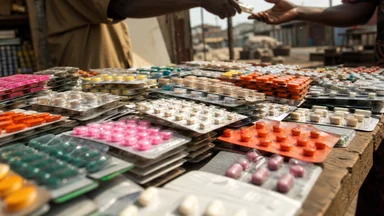
On a dusty street in Ajegunle, a crowded district of Lagos, Nigeria, a market stall displays neat rows of antibiotic capsules. The seller, a young man who gives his name as Tunde, assures a customer that the amoxicillin he offers is strong and effective. But the pills inside the blister packs may be chalk, talc, or a fraction of the correct dose. "We buy from middlemen," Tunde admits when pressed. "We don't know the factory. The price is good, so we sell." This scene, repeated across the city's sprawling slums, is a front line in the battle against antibiotic resistance—a battle that is being lost.
The Counterfeit Amoxicillin in the Market Stall
The problem is not new, but it is worsening. Slum pharmacies and medicine vendors stock lookalike antibiotics that are often indistinguishable from genuine products. The packaging mimics legitimate brands, complete with NAFDAC registration numbers that may be copied or invented. Inside, the contents vary: some capsules contain only powdered chalk or talc, others have a sub-therapeutic dose of the active ingredient, and a few are outright toxic.
Patients, many of whom cannot afford a clinic visit, buy these drugs for a fraction of the price of a legitimate prescription. They pay for relief and get inert filler. The cost is measured not in naira alone but in treatment failure. A child with pneumonia takes a course of fake amoxicillin, the fever persists, and the family spends more money on another antibiotic, often also counterfeit. The cycle repeats until the child is brought to a hospital in critical condition.
The economic pressure is immense. In Lagos, where over half the population lives in informal settlements, a full course of a genuine antibiotic can cost several days' wages. The counterfeit market thrives because it offers a cheaper alternative, even if it is ineffective. As one community health worker put it, "They know it might not work, but it's all they can afford."
Resistance builds when bacteria are exposed to sub-lethal doses. The microbes that survive a weak antibiotic multiply, passing on resistance genes. Each course of fake medicine is a selection event, favoring the hardiest bacteria. The result is a reservoir of resistant strains that circulate in crowded neighborhoods, where sanitation is poor and infections spread easily.
Beyond the obvious clinical failure, there is a subtler harm: the erosion of trust in the health system. When a patient takes a course of medicine and does not improve, they may conclude that antibiotics are useless, or that the disease is stronger than any treatment. This discourages them from seeking proper care in the future, pushing them further into the arms of informal vendors. A 2021 survey by the Nigerian Medical Association suggested that nearly half of patients who self-medicate with antibiotics report a previous treatment failure, and many attribute it to the drug rather than the disease. This misattribution has a corrosive effect on public health messaging, making it harder for clinicians to convince patients to complete courses of genuine medication.
How the Supply Chain Turns Blind
The supply chain for medicines in Nigeria is fragmented. Open drug markets, such as Idumota on Lagos Island, are the primary source of pharmaceuticals for many low-income neighborhoods. These markets operate with little oversight. Regulators, including the National Agency for Food and Drug Administration and Control (NAFDAC), lack the staff and resources for routine inspections. Seizures happen, but they cover only a fraction of what is sold.
Genuine drugs are often diverted from legitimate channels, repackaged, and relabeled. Expired stock is given new dates. Counterfeiters exploit porous borders and weak enforcement. A packet of antibiotics may cross several countries before reaching a Lagos stall, its provenance lost. There is no cold chain for those that require it, no batch tracking, no recall system.
The World Health Organization estimates that 1 in 10 medical products in low- and middle-income countries is substandard or falsified. In Nigeria, some studies put the figure higher for antibiotics. The blind supply chain means that neither the seller nor the buyer knows what is really in the packet. The seller is often as deceived as the customer, relying on wholesalers who are themselves in the dark.
Efforts to improve regulation exist. NAFDAC has a track-and-trace pilot, and mobile testing laboratories have been deployed. But these are small-scale compared to the volume of trade. The agency's director general has repeatedly called for more international cooperation and stronger border controls. Yet, the sheer size of the informal market makes enforcement daunting.
There is also the question of accountability. In the formal supply chain, a pharmacist who dispenses a substandard drug can be held liable. In the informal market, sellers operate with impunity, often moving from one location to another to avoid detection. The anonymity of the market is a shield. Even when a batch is identified as counterfeit, tracing it back to the original manufacturer is nearly impossible. This lack of accountability further undermines trust and allows the problem to persist.
The Deadly Arithmetic of Sub-Lethal Doses
The science is straightforward: when bacteria are exposed to antibiotic levels that are too low to kill them, they can mutate and develop resistance. This is a Darwinian process, and it is accelerated in densely populated slums where infections are frequent and antibiotics are used indiscriminately. A study published in 2019 by researchers at the University of Lagos found that 40% of antibiotic samples bought from open markets in the city were substandard, meaning they had less than the required amount of active ingredient.
Common infections that were once easily treatable are becoming untreatable. Tuberculosis, a major killer in Nigeria, has seen a rise in multidrug-resistant strains. Typhoid, spread through contaminated water and food, is now often resistant to first-line antibiotics. The cheap drugs that used to work no longer do, forcing patients to buy more expensive second-line treatments that are often out of reach.
The arithmetic is cruel. A single course of sub-lethal amoxicillin can leave a child's body with a population of resistant bacteria. That child may then spread those bacteria to siblings, neighbors, and classmates. In a slum where hundreds of people share toilets and water sources, the resistance genes travel fast. Hospitals in Lagos are already reporting cases of sepsis from resistant E. coli that are difficult to treat.
The global community has warned of a post-antibiotic era. The World Health Organization calls it one of the biggest threats to global health. Antibiotic resistance is estimated to cause over 1 million deaths a year worldwide, and that number is expected to rise. Without effective antibiotics, routine procedures like cesarean sections and chemotherapy become dangerous. The burden falls hardest on the poor, who cannot afford newer, more expensive drugs.
But there is a counterargument worth considering: is the counterfeit market truly the main driver of resistance, or is it merely a symptom of a deeper problem? Some researchers argue that the overuse of antibiotics in agriculture and the indiscriminate prescribing by qualified doctors are equally significant contributors. In Nigeria, antibiotics are available without prescription even in some licensed pharmacies, and doctors, under pressure from patients, may prescribe them for viral infections. The counterfeit market exacerbates the problem, but it does not create it. Addressing resistance requires a comprehensive approach that includes regulating the informal market, curbing overuse in agriculture, and educating both prescribers and patients.
Patient Stories: Fever, Diarrhea, and No Cure
Adaeze, a mother of three living in Makoko, a slum built on stilts over the Lagos lagoon, recalls the ordeal of her youngest son. He developed a fever and diarrhea. She bought what she thought was amoxicillin from a local chemist. "The seller said it was good, very strong," she says. "I gave it for three days, but the fever did not go." She spent more money on another antibiotic, then on traditional remedies. Eventually, she took the child to a hospital, where a stool test revealed an E. coli infection resistant to multiple antibiotics. The child recovered after a course of a third-line drug that cost ten times what she had paid at the market.
Stories like Adaeze's are common. A market vendor in Ajegunle, who asked not to be named, developed a wound infection after a cut on his hand. He bought a topical antibiotic ointment from a street seller. The infection worsened, spreading up his arm. At a clinic, he was told the bacteria were resistant to the first-line treatments. He had to take a longer, more expensive course.
Surveys suggest that up to 70% of slum dwellers self-medicate, often with antibiotics obtained without a prescription. The trust in local pharmacists is eroding as deaths climb. Yet, for many, there is no alternative. The nearest public health facility may be hours away, and the cost of a consultation is prohibitive.
Community health workers are a vital link. They can teach proper dosing and warn against buying from open markets. But they are few and overstretched. Some organizations, like the Society for Family Health, run programs to improve awareness, but the reach is limited.
There is also the issue of gender dynamics. Women, who are often the primary caregivers for children and the elderly, bear the brunt of the burden. They are the ones who must decide whether to spend scarce resources on a doctor's visit or on food. A study in the Lancet Infectious Diseases in 2020 noted that in urban slums, women are more likely to self-medicate due to time constraints and cultural expectations. They may not have the freedom to travel to a distant clinic, and they may be less likely to question a vendor's claims. Empowering women with accurate information is therefore not just a matter of health education, but of gender equity.
The Evidence: Testing Fake Pills in Lagos Labs
The evidence is mounting. A 2019 study by researchers at the University of Lagos collected 100 samples of antibiotics from pharmacies and open markets across the city. Using high-performance liquid chromatography, they found that 40% were substandard, with the active ingredient well below the labeled amount. The counterfeit rate was higher for antibiotics than for other drugs, a finding consistent with global data.
NAFDAC has stepped up seizures. In 2023, the agency reported seizing millions of naira worth of fake drugs, including antibiotics, in raids on markets in Lagos and other states. But these seizures are a drop in the ocean. The agency estimates that the illegal trade is worth billions of dollars annually, and its enforcement capacity is limited by funding and corruption.
Lagos State's own laboratory, the Lagos State Drug Quality Control Laboratory, has confirmed that many samples submitted for testing lack the active ingredient entirely. The lab has become a reference point for researchers, but it cannot test every batch that reaches the market.
International organizations are paying attention. The Global Antibiotic Resistance Partnership has called for stronger regulatory frameworks and better surveillance. The World Health Organization has launched a global surveillance system for substandard and falsified medicines. But progress is slow, and the street markets remain largely unregulated.
One of the challenges in testing is the cost. High-performance liquid chromatography machines are expensive, and reagents are not always available. Mobile testing kits, such as the Global Pharma Health Fund's Minilab, offer a cheaper alternative, but they are not widely deployed. The result is that most testing is done on a random basis, and the data collected is often incomplete. A more systematic approach, perhaps using blockchain technology to track batches, has been proposed but remains untested in this context.
What Can Be Done: From Vigilance to Regulation
There is no single solution. On an individual level, experts advise buying from licensed pharmacies, not open markets. Look for the NAFDAC registration number on the packaging and check the expiration date. If a drug does not seem to work, seek medical advice rather than buying more. The government has set up a mobile hotline for reporting suspicious drugs, and people are encouraged to use it.
Community health workers can play a crucial role in educating families about proper antibiotic use. They can teach that antibiotics are not for viral infections like the common cold, and that a full course must be completed even if symptoms improve. This is a hard sell in communities where money is tight and a saved tablet is seen as a resource.
On a regulatory level, Nigeria needs stronger port inspections and a track-and-trace system that can follow a drug from manufacturer to consumer. NAFDAC has piloted such a system, but it has not been scaled. International cooperation is essential, as many counterfeit drugs are produced in other countries and smuggled across borders.
There are also market-based approaches. Some organizations are working with pharmacies to certify them as reliable. Others are pushing for cheaper generic antibiotics to undercut the counterfeit market. But these efforts are in their infancy, and the counterfeit industry is adaptive.
Reasonable people disagree on the priority. Some argue for stricter penalties, others for better education. The truth is that both are needed. The government cannot inspect its way out of this problem, and education alone will not stop a desperate mother from buying the only medicine she can afford.
There is also the role of the pharmaceutical industry. Some companies have begun to use tamper-evident packaging and unique codes that can be verified by mobile phone. However, these measures are not universal, and counterfeiters have been known to replicate even these features. A more radical approach would be to reduce the price of genuine antibiotics through subsidies or public-private partnerships, making the counterfeits less attractive on a cost basis. This has been done for antimalarials in some countries, with mixed results.
The Cost of Inaction in the Next Epidemic
The cost of inaction is impossible to quantify. Antibiotic resistance could kill 10 million people a year by 2050, according to some projections. Slums like those in Lagos are epicenters for resistant strains. A resistant bacterium that emerges in a slum can travel the world in a day. The next epidemic may not be a new virus but a familiar infection that no longer responds to treatment.
Global health agencies warn of a post-antibiotic era, where a simple cut can be fatal. The warning has been repeated for years, yet the response has been inadequate. Funding for antibiotic development is scarce, and the pipeline is thin. The market does not reward long-term investment in drugs that are meant to be used sparingly.
Lagos serves as a warning for other megacities. The conditions that breed resistance are present in Dhaka, Nairobi, and São Paulo. The patterns are the same: poverty, overcrowding, weak regulation, and a thriving informal market. What happens in Lagos is not isolated; it is a preview of the global future.
Without immediate action, the next epidemic may be one of untreatable infections. The tools to prevent it exist: better regulation, smarter enforcement, and honest education. But they require political will and sustained funding. The people of Ajegunle and Makoko cannot wait for that. They need safe, effective antibiotics today. The alternative is a future where a child's fever is a death sentence, and the market stall that sold the fake amoxicillin is a silent accomplice.
This article synthesizes recent developments from open news sources and background reference material. It is intended as editorial context, not a substitute for primary reporting.