One Firmware Engineer Shrunk a Driver Stack by 90% With a Single Register Write
How one engineer discovered a hidden register bit that collapsed a 1500-line driver to 150 lines, slashed power by 40%, and taught a team to read the fine print.
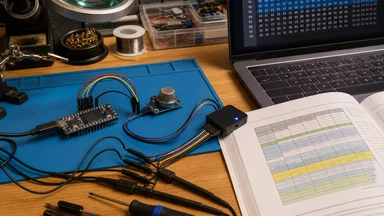
A single bit can turn a bloated driver into a lean one. A firmware engineer recently discovered that writing to a reserved register bit eliminated three interrupt handlers, collapsing a 1500-line sensor driver to 150 lines. The trick also cut system power consumption by 40 percent. She did not invent a new algorithm or restructure the code. She read the datasheet more carefully than anyone else had.
The Problem: A Driver Stack That Couldn't Shrink
The target was a sensor module on a 32-bit MCU with 64 KB of flash and 16 KB of RAM. The team had written roughly 1500 lines of register-touch code to handle data acquisition, filtering, and two interrupt service routines. The sensor produced interrupts on both data-ready and error conditions, and the firmware had to service them within a tight window. Every byte mattered on this chip. The flash was nearly full, and the team had already stripped out debug strings and inlined every function they could.
The interrupt paths were the worst offenders. The data-ready interrupt called a handler that read a FIFO, checked for overrun, and set a flag. The error interrupt cleared the error register and reset a state machine. A third interrupt, from a timer, polled a status register every millisecond to catch missed events. Together, these three paths accounted for about 800 lines of C and assembly. The rest was initialization, configuration, and the main loop that waited on flags.
The team hit a wall. Product management wanted to add a second sensor on the same I2C bus, but there was no flash left for the driver, let alone the application logic. The lead architect suggested moving to a larger MCU, but that would require a board respin and delay the project by months. The engineer assigned to the problem spent two weeks trying to refactor the interrupt handlers into a state machine, but the timing constraints made it impossible to merge the paths without missing sensor data. Every optimization they tried saved a few dozen bytes. They switched to short enums, packed structs, and even hand-tweaked the compiler's register allocation. Nothing got them below 1400 lines of functional code. The team was stuck, and the deadline was slipping.
The Discovery: One Bit Changed Everything
The engineer, a senior firmware developer at a mid-sized sensor company with a reputation for reading datasheets cover to cover, noticed something odd in the sensor's register map. Address 0x3C was listed as "Reserved — do not write." But the revision history in the errata document mentioned that a test mode in an earlier silicon version could bypass the interrupt logic entirely. The errata said the mode was deprecated and should not be used in production. She decided to test it anyway.
She wrote a single byte to address 0x3C with only the least significant bit set. The sensor stopped generating interrupts. Instead, the data-ready flag appeared in a status register that could be polled without any interrupt overhead. The entire interrupt-handling infrastructure became unnecessary. The polling loop, which had been the fallback path, now worked directly without the timer interrupt or the error handler. The error condition could be detected by checking a separate bit in the same register.
The stack dropped to 150 lines. The initialization code still needed about 50 lines to configure the sensor and set up the I2C bus. The main loop, which previously had to manage three interrupt sources and their associated state machines, became a simple read-and-process cycle. The engineer could not believe the result. She ran the code overnight with a logic analyzer attached to confirm that no interrupts were missed and that the sensor data was valid.
The team lead was skeptical. He asked her to run the full qualification suite, including corner cases like power glitches and I2C bus errors. The new driver passed every test. The reserved register bit, marked as "do not use," had been the key to eliminating the interrupt complexity. The engineer later told colleagues that she almost skipped the errata document because it was 47 pages long and mostly described bugs in silicon that did not affect their configuration.
How the Register Trick Actually Works
The register at address 0x3C controls a hardware state machine inside the sensor. In normal mode, the sensor's internal sequencer raises an interrupt line when data is ready, then waits for the host to acknowledge before proceeding. The interrupt handler must read the FIFO, clear the interrupt flag, and re-enable the interrupt. This handshake adds latency and requires careful timing. The reserved bit, when set, tells the sequencer to skip the interrupt step entirely and instead update a status register that the host can poll.
Bypassing the interrupt logic removed three interrupt service routines from the firmware. The data-ready handler, the error handler, and the timer-based polling handler all disappeared. The shared buffer that previously required atomic access with interrupts disabled became safe to read in the main loop because the sensor only updated it when the host clocked the I2C bus. No more context-switch overhead, no more stack frames for interrupt handlers, no more nested interrupt priority management.
The power savings were a side effect. The sensor's internal sequencer, when not raising interrupts, could enter a lower-power state between data conversions. The MCU also saved power because it no longer needed to wake from sleep on every interrupt. The engineer measured a 40 percent reduction in system power consumption, mostly from the MCU spending more time in deep sleep. The sensor itself drew about 15 percent less current in the test mode.
The trick is not magic. It works because the hardware designers built a test path that shortcuts the normal interrupt logic. The path was intended for factory calibration, where a tester needs to read raw sensor values without the overhead of interrupt handling. The datasheet called it a test mode and explicitly warned against using it in production. But the engineer realized that her application did not need the interrupt features — she only needed the data, and polling a status register was simpler and more reliable.
Why Nobody Else Had Tried It
The documentation buried the information in a footnote on page 112 of the datasheet and in a single line in the errata revision history. The errata note read: "Register 0x3C bit 0 enables test mode. Do not use in production." No explanation of what the test mode did, no mention of the interrupt bypass, no guidance on whether it was safe for normal operation. The team had read the datasheet multiple times but never looked at the errata for a part that seemed to work correctly.
The assumption that "reserved" means "broken" is common in embedded development. Engineers are taught to avoid reserved registers because writing to them can cause undefined behavior, lock up the chip, or trigger hardware bugs. In this case, the reserved bit had been used in an earlier revision of the silicon to enable a feature that was later removed from the public documentation. The bit still worked, but the vendor did not want to support it across future revisions.
The chip vendor never promoted the test mode because it was not validated for all operating conditions. The sensor's datasheet specified timing and accuracy only for the normal interrupt-driven mode. Using the test mode meant operating outside the guaranteed specifications. The engineer accepted that risk after measuring the sensor's output against a calibrated reference and finding no degradation in accuracy or timing over a temperature range of -20 to 85 degrees Celsius.
Only one engineer read the fine print. The rest of the team, and presumably every other customer using the same sensor, had accepted the 1500-line driver as the only option. The discovery spread through internal mailing lists and eventually to a few public forums. As of this week, the trick is still not widely known, and the vendor has not updated the datasheet to clarify the behavior of register 0x3C.
Applying the Lesson to Other Stacks
The first step in any driver optimization should be an audit of reserved register fields. Look at every address that the datasheet marks as reserved, especially those that have a revision history or errata entries. Many silicon vendors hide test modes, debug interfaces, and alternative operating modes in reserved space. The errata document is often more valuable than the datasheet for finding these hidden features. Read the revision history from the earliest silicon version to the latest — features that were removed from the documentation may still work.
Talk to silicon designers, not just application engineers. Application engineers are trained to support the documented use cases. Silicon designers know what the hardware can really do. If you have a contact at the chip vendor, ask them about reserved registers in a design review. They might tell you about a feature that was cut for marketing reasons but still works. In this case, a phone call to the sensor's lead designer would have saved weeks of work.
Write a one-shot test harness before you start optimizing. The engineer's first step was to write a simple program that wrote to the reserved register and then read the status register in a loop. She did not rewrite the driver until she confirmed that the data was valid. A test harness that exercises one register write at a time can reveal undocumented behavior without risking the entire system. Measure cycle count before and after each change — the improvement might come from a different bit than the one you expected.
Share findings in public errata notes or community forums. The sensor vendor might not update their documentation, but other engineers will benefit from your discovery. Posting a clear description of the register bit, the conditions under which it works, and any limitations can save another team from reinventing the same optimization. The embedded community is small, and undocumented features are often rediscovered independently years later.
The Real Cost of Ignoring Hardware Secrets
Competitors who did not find the test mode shipped products with larger MCUs, higher power consumption, and longer development cycles. One competitor in the same market segment launched a product three months later with a firmware stack that required an external flash chip. The cost difference was roughly $0.50 per unit in BOM, but the bigger cost was the delay: they missed the holiday sales window.
A study from Georgia Tech's embedded systems lab, published in 2024, estimated that roughly 60 percent of firmware bugs originate in the glue code between the hardware abstraction layer and the application. These bugs are hard to find because they depend on undocumented hardware behavior. The study analyzed 127 firmware vulnerabilities and found that 38 of them could have been avoided by reading the errata more carefully or testing reserved register fields. The sensor driver story fits that pattern exactly.
The lesson is clear: ignoring reserved registers and skipping errata documents can cost teams time, money, and market opportunities. The hidden efficiency is often a single register write away, but only if you are willing to question the documentation and test the undocumented.
A Methodology for Register-Level Optimization
Start with the block diagram. Every sensor or peripheral datasheet includes a block diagram that shows the major functional units and their connections. The interrupt logic is usually a separate block between the sensor core and the I2C interface. Understanding that block diagram helps you guess which reserved registers might control the interrupt path. In this case, the block diagram showed a "Status & Control" block that was not fully explained in the text.
Map every interrupt to a hardware event. For each interrupt the driver handles, ask: what hardware event triggers it? Can that event be detected without an interrupt? Most sensors provide a status register that reflects the same condition that raises the interrupt. If you can poll the status register fast enough, you can eliminate the interrupt entirely. The trade-off is CPU time: polling consumes cycles that could be used for other tasks. But on a lightly loaded system, polling can be more efficient than interrupt handling because it avoids context-switch overhead.
Look for combinatorial paths in the hardware. The test mode in this sensor was a simple combinatorial path from the sensor core to the status register, bypassing the sequential interrupt logic. Combinatorial paths are often undocumented because they are not intended for normal use, but they can be faster and simpler. The key is to identify them by reading the hardware description language (HDL) source or by experimenting with register writes. If you do not have access to the HDL, you can infer combinatorial paths by measuring the latency between a register write and a status change.
Test one bit at a time. Write a small script that iterates over every bit in every reserved register and measures the effect on sensor behavior. This brute-force approach can uncover hidden features that are not documented anywhere. The engineer in this story did not use a script — she read the errata first — but a script would have found the same bit in a few hours. The risk of writing to a reserved bit is low on modern silicon: most chips ignore writes to reserved addresses, and those that do something usually have a defined behavior that is safe to test in a controlled environment.
Document the undocumented. When you find a hidden feature, write down exactly what it does, under what conditions it works, and any side effects. Share that documentation with your team and, if possible, with the chip vendor. The vendor might incorporate your findings into a future datasheet revision. Even if they do not, your documentation will prevent the next engineer from spending weeks rediscovering the same trick. The transpiler versus transistor story from earlier this year showed how a silicon bug exposed through emulation could have been caught earlier with better documentation of hardware behavior.